What teardrop flags are used for
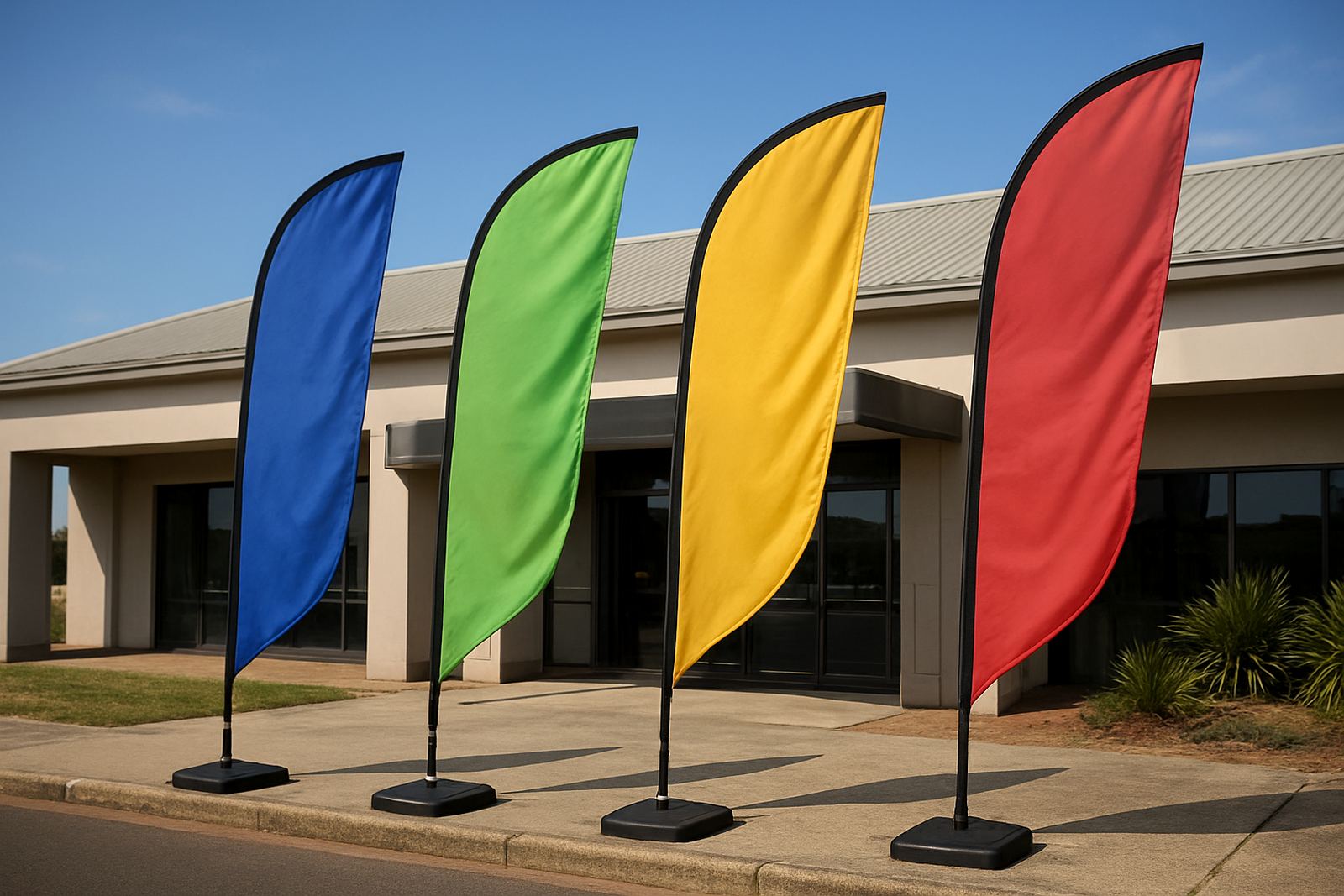
Teardrop flags are tall lightweight display flags shaped to hold their curve in the wind, with a printed sail fixed to a flexible pole set. They are commonly used where you need passing traffic to notice a business, special offer or event from a distance. At street level they work well outside car dealerships, tyre centres, fuel forecourts, quick-service restaurants, hardware yards and temporary launch sites.
In Durban conditions, especially close to the coast, the right flag setup matters. Salt air, strong afternoon wind and summer rain can shorten the life of poor-quality hardware, so the print, pole and base all need to suit the site. For exposed roadside positions we normally recommend a proper ground spike or weighted base and a double-sided print if the message must be read from both directions.
- Good for short-term promotions and longer-term outdoor branding
- Useful where wall space is limited or signage cannot be fixed to a building
- Easy to move between sites for launches, weekends and events
- Works with branded artwork, directional messages or price-led promotions
Sizes, shapes and print options
Teardrop flags are available in different heights depending on how far you want the sign to sit above the ground and how much visibility you need above parked cars, hedges or boundary walls. A smaller unit can suit a sidewalk entrance, while a taller option gives better street presence for forecourts and larger yards. The curved shape keeps the flag taut so the printed area stays readable even when there is movement in the air.
Print is done on durable outdoor flag fabric with reinforced edges and a sleeve or clip system depending on the pole set. We can produce single-sided flags with a mirrored reverse, or full double-sided options where the artwork must read correctly from both sides. For branding that includes fine text or logos, we advise checking the design at full size because small lettering can lose legibility when viewed from a moving vehicle.
- Common sizes: 2.4 m, 3.2 m and 4.0 m overall height
- Single-sided or double-sided print available
- Lightweight aluminium or composite pole set
- Ground spike, cross base with water bag, or weighted plate base
Where teardrop flags suit best
These flags are ideal for places where traffic moves slowly enough to notice branding but not so slowly that a large fixed sign is needed. They also help when you need extra visibility for a limited period, such as a new opening, seasonal offer or product launch. Because the flag stands off the ground and keeps moving slightly in the wind, it catches the eye without blocking the entrance.
Across eThekwini, Umhlanga, Pinetown and the North Coast, we install flags for business parks, forecourts, showrooms, roadside yards and event entrances. They are also useful at municipal-facing sites where you need clear temporary branding for a launch or roadshow. If your site has underground services, paving restrictions or narrow verge space, the base choice needs to be checked before installation so the flag can be secured properly and not become a hazard.
- Forecourts and vehicle entrances
- Store openings, product launches and trade days
- Roadside exposure on suburban and arterial roads
- Indoor and outdoor events with controlled foot traffic
Installation, anchoring and site conditions
Teardrop flags do not need electricity or gas, which makes them useful during load-shedding and at sites where power is still being connected. The main requirement is a stable fixing method that suits the surface. On grass or soil we normally use a ground spike. On paved areas, concrete or forecourts, a cross base with a weighted bag or heavy plate is usually better. In windy coastal areas the base should be chosen carefully, because a light stand can shift or tip if it is not matched to the site.
Our team can assist with site surveys, setting out and installation so the flag sits in the right position relative to the road, entrance and parking bay layout. If the flag is going into a high wind area, we may recommend removing it after trading hours or during severe weather. That helps protect the pole set and keeps the fabric from wearing too fast.
- No mains power required
- No gas or fuel requirement
- Base choice depends on surface and wind exposure
- Can be installed as a single unit or in a paired run for stronger visual impact
Care, servicing and replacement planning
Outdoor flags need regular checking if you want them to stay neat. Sun, rain and salt air will eventually fade the print, fray the hem or loosen fittings. A quick monthly check is usually enough for most sites, although busy roadside locations may need more frequent attention. If the fabric starts to curl at the edges or the flag is no longer standing properly, the sleeve or pole may need servicing.
We also handle sign maintenance, removals and refurbishment work where a flag needs to be taken down, reprinted or moved to another site. For businesses with multiple branches, it helps to keep one spare flag in the system so damaged units can be swapped out quickly. That reduces downtime and keeps the site looking cared for rather than patched up.
- Wipe down with mild soapy water and a soft cloth
- Do not use harsh solvents or abrasive pads
- Check stitching, pole joints and base fittings regularly
- Replace worn fabric before it tears further in wind
What to check before you place an order
Before ordering, measure the available space and think about how the flag will be seen from cars, pedestrians and turning traffic. If the artwork is for a new promotion, confirm the wording early so production can start without delay. You should also decide whether the flag is for one site or for repeated use across several branches, because that affects the base type and the amount of wear expected.
We will normally ask for your logo, the message you want on the flag, the preferred colours and whether the artwork should read from one side or both. It also helps to know if the site is paved, grassed or exposed to strong wind. Where needed, we can assist with artwork setup and advise on the right proportion of text, logo and contact details so the message stays readable from a moving vehicle. Better to get that right first time than replace a print that was too busy.
- Overall height and available ground space
- Indoor or outdoor use
- Single-sided or double-sided print
- Ground spike, cross base or weighted plate
- Exposure to wind, salt air and weather
- Whether the flag will be moved between branches or kept on one site
Key facts
| Product type | Outdoor teardrop flag display system |
|---|---|
| Typical heights | 2.4 m, 3.2 m or 4.0 m overall |
| Print options | Single-sided or double-sided |
| Pole material | Lightweight aluminium or composite |
| Base options | Ground spike, cross base, weighted plate |
| Power or gas needs | None required |