Choose the spot before you choose the size
A banner is not just a printed sheet, it is a message that has to fight for attention against traffic, trees, poles, walls and weather. The first step is to place it where people naturally look. In busy areas around Briardene, Umhlanga, Pinetown and the North Coast, that usually means along fence lines facing traffic, near pedestrian entry points, or at the first bend leading into a venue. If the banner is hidden behind parked vehicles or set too far back from the road, the value drops fast.
For roadside use, height matters as much as width. Drivers need enough viewing time to read the message at speed, so the banner should sit clear of grass, rubble and low branches. At event approaches, the banner should help visitors make a turn or find the entrance without stopping in unsafe places. That is why a quick site survey saves time later, especially where municipal sidewalks, servitudes or shared access ways come into play.
Fence lines that hold up in wind and salt air
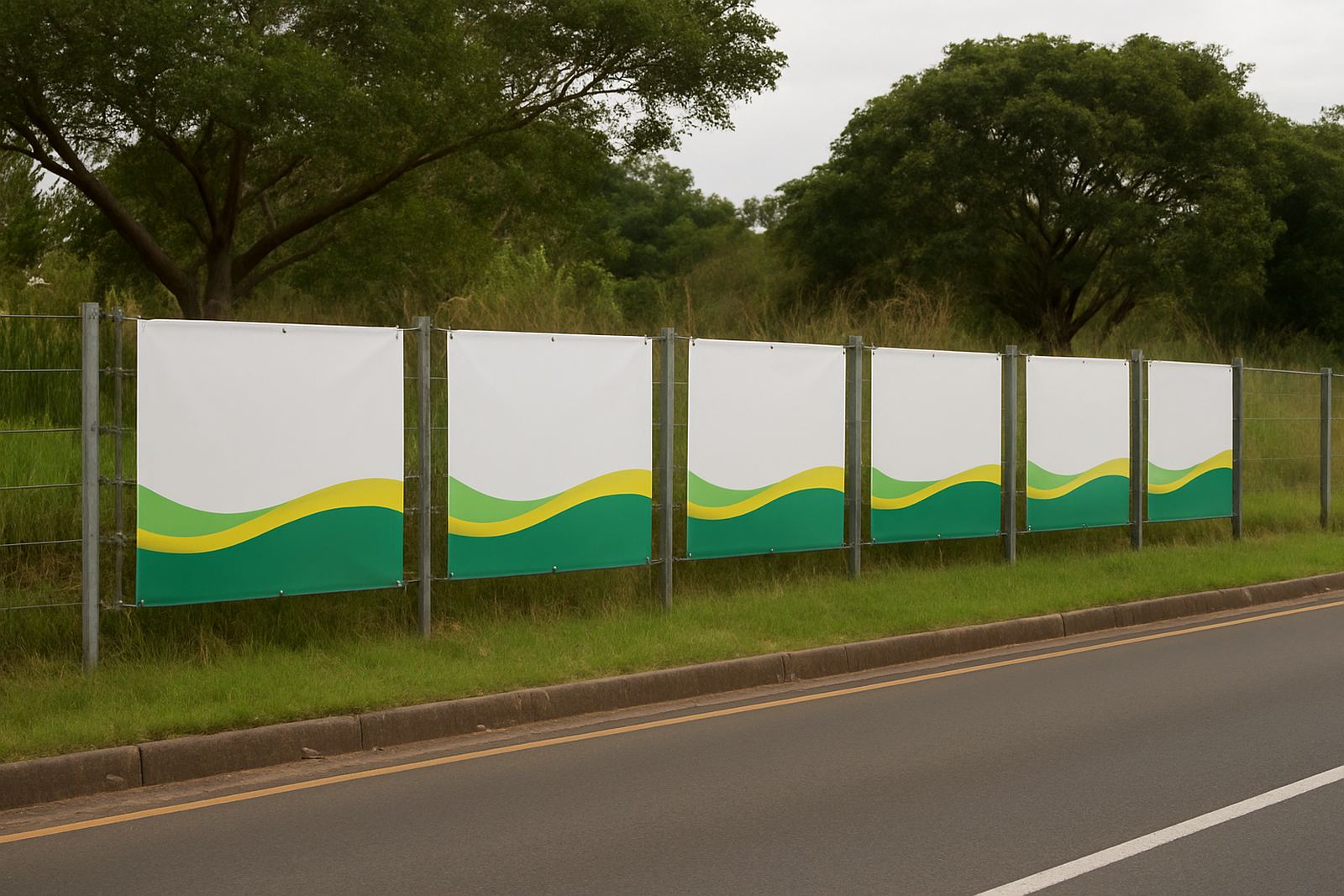
Fence mounting is one of the most common outdoor banner placements in Durban because it is practical and usually cost effective. Chain-link fences, welded mesh and temporary crowd-control barriers all take banners well if the fixing points are planned properly. In coastal areas, salt air and strong afternoon wind can shorten the life of poor fixings, so the banner should be secured with the right spacing and edge reinforcement. A loose banner starts to flap, then tear, then pull at the eyelets.
Good fence placement also depends on what is behind the fence. If there is shrubbery, a wall or a yard cluttered with materials, the banner can lose impact. A plain background gives better contrast and makes the print easier to read. For long fence runs, it often works better to use several panels rather than one oversize banner that catches too much wind.
- Use fence lines where foot traffic and vehicle traffic both pass the site.
- Keep the lower edge high enough to avoid dirt splash and standing water.
- Allow for wind movement near corners, gates and exposed ends.
- Check for sharp edges on the fence before installation.
Roadside banners need a clear reading distance
Roadside placement is useful for promotions, property launches, construction notices and event direction. The aim is not to crowd the banner with too much copy. Most motorists will only read a few words, so the message should be direct and the phone number or call to action should be easy to find. If the banner sits close to a fast road, larger lettering and fewer words are better. On slower streets, pedestrians may have more time to take in the details.
In Durban North and around the approach roads to Umhlanga, roadside banners often work best where vehicles are slowing for a turn, a robot or a gate. That gives the viewer a few extra seconds. The placement should never block sight lines for drivers leaving a property, and it should not interfere with municipal signage or traffic control points. One wrong angle can turn a useful banner into a distraction.
- Choose a position where the banner faces oncoming traffic, not side-on.
- Keep wording large enough to read from the opposite side of the road.
- Avoid poles, trees and security fencing that break up the full message.
- Confirm that the site allows temporary display without blocking access or visibility.
Event approaches need guidance, not clutter
At events, outdoor banners do more than advertise. They help people find the entrance, identify parking and move in the right direction. This is especially useful at sports grounds, school fairs, church gatherings, exhibitions and coastal venues where first-time visitors may arrive in a hurry. A banner at the wrong point can get missed entirely, but one placed too early or too late can confuse people. The best spot is usually the point where a visitor has already made the turn and needs confirmation that they are in the right place.
For event approaches, one banner at the main entry and a second at the decision point often works better than several small signs scattered around. If the route includes a fence line or pedestrian path, the banner should guide people without forcing them into the road. On windy days, especially near open fields or seaside venues, it is better to use a secure fixing method than to chase a bargain solution that fails at the gate.
Material choice changes where a banner can go
Not every banner material suits every spot. Some positions need extra strength, while others need easier handling for repeated use. A banner on a temporary fence near an event entrance can be removed and re-used, while a banner on a long-term roadside boundary may need better finishing and more durable edges. If the banner is exposed to direct sun, rain and salt spray, print quality and lamination choices should be considered carefully before installation.
We also look at how the banner will be read alongside other signage on site. In a retail yard or industrial entrance, a banner may need to work with light boxes, wall signs or window graphics. The goal is consistency. If one sign is shouting while the next is too small, the site feels untidy and the message gets lost.
Durban conditions make installation details matter
Local conditions are not a side note. In eThekwini, strong coastal wind, heat and heavy summer rain can all affect banner performance. Add load-shedding, and some sites become harder to work on because lighting is limited in the early morning or late afternoon. That makes planning even more important. The installation team must know whether the ground is level, whether access is shared, and whether there is enough space for ladders, tools and fixings.
For businesses in Briardene, Westville, Phoenix, Verulam, Tongaat and Ballito, we often advise on placement before anything is printed. That saves wasted material and avoids last minute changes. It also helps with maintenance, because a banner that is easy to reach can be cleaned, tightened or replaced without disrupting trading. A well placed banner should look right on day one and still hold its shape after a week of coastal weather.
A local example from a busy approach road
A practical example is a banner for a weekend market on the KZN North Coast. The organisers needed people to spot the entrance from the main road, then find the parking area without stopping in traffic. One banner was fixed to a fence facing the oncoming lane, and a second was placed deeper inside the property at the turnoff. The first banner built awareness, while the second confirmed arrival. That simple two point layout worked better than one oversized banner at the gate, because the gate itself was hidden by traffic and roadside vegetation.
This kind of placement thinking matters for all outdoor banners. The best spot is not always the biggest wall or the nearest fence. It is the place where the message has time to be seen, the banner can be secured properly, and the visitor can act on it safely. When those three things line up, the banner does its job and keeps doing it well.