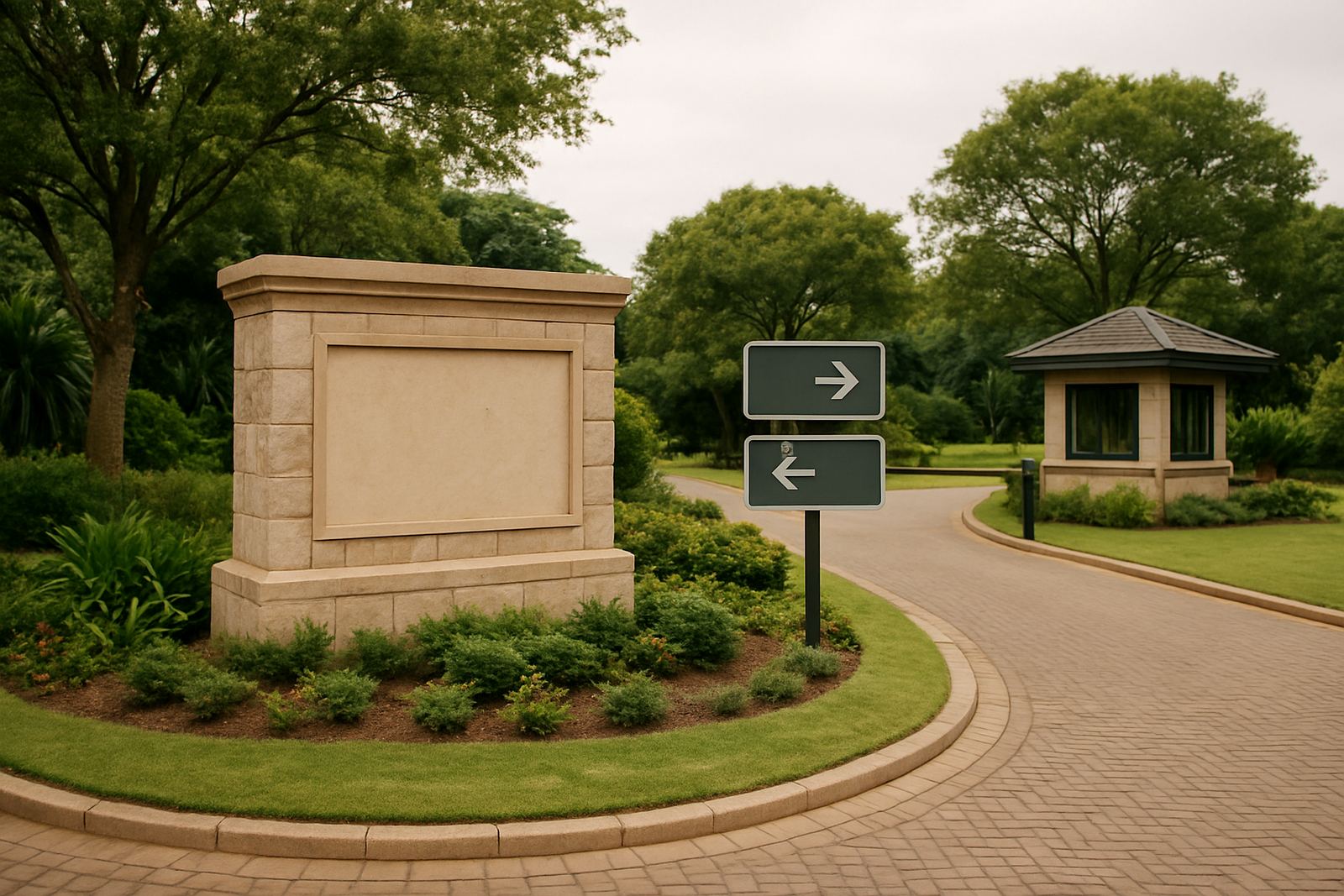
What an estate entrance sign has to do at the gatehouse
An estate entrance sign has a very practical job. It must be easy to see from the road, readable for first time visitors, and neat enough to suit the estate’s image. At the same time, it has to hold up to Durban weather, security lighting, dust, and the daily wear that comes with boom gates, deliveries and resident traffic.
At Briardene, we often see estates needing more than one sign solution at the entrance. A main identity sign may sit above or beside the gatehouse, while smaller panels carry rules, visitor instructions, office hours, body corporate notices, or directional arrows. When these are planned together, the entrance looks ordered rather than cluttered.
Good entrance signage also helps security teams. If a driver can find the visitor lane, intercom point or delivery bay without stopping in the road, the entrance works better for everyone.
Choosing the right material for Durban conditions
Coastal weather changes what works and what does not. In eThekwini and along the North Coast, salt air and moisture can shorten the life of low grade materials. Sun exposure is another factor, especially on open gates and perimeter walls with very little shade.
For estate entrance signs, material choice should match the location and the level of maintenance the estate is willing to do. We usually recommend a material and finish based on visibility, fixings and whether the sign will be mounted on a wall, gatehouse fascia, pylon or freestanding frame.
- Chromadek: useful for external panels that need a clean painted steel surface and good weather resistance.
- Perspex: suited to modern layered signs, illuminated faces and cleaner edge detail.
- ABS: a practical option for shaped lettering and smaller sign components.
- Vinyl graphics: ideal for logos, wording and wayfinding on flat panels or glass.
- Light boxes: useful where the entrance must be visible after dark and through load-shedding.
We also advise on print lamination where the sign faces need extra protection from UV and cleaning chemicals. That small step often extends the useful life of the sign by years.
Design that stays neat, even when information changes
Estate entrances often carry more information than people first expect. There may be the estate name, a security notice, a visitor process, a pedestrian rule, a no stopping warning and a contact instruction for the guard room. If all of that is forced onto one board, the result is hard to read from a moving vehicle.
The better approach is to separate the message into clear layers. The estate identity should be the main feature. Operational notices should be smaller and set lower, where they do not compete with the main name. Fonts should stay legible at a distance, and colours should work under both daylight and night lighting.
We also pay attention to how the entrance is seen from the road. A sign facing direct sunlight may need stronger contrast. A sign under a canopy may need more brightness. If there is a security fence, the sign should be placed where it can be read before the driver reaches the boom. That simple detail cuts confusion and makes the entrance feel more controlled.
Gatehouse, wall or pylon: where the sign should go
Placement matters just as much as the material. A sign can be well made but still underperform if it sits too low, too high, or too far from the approach line. For estates with a long entrance drive, the sign may need to be visible from the road as well as from the gatehouse. For tighter sites in Durban North or Pinetown, a wall mounted sign may be the best option.
We look at sightlines, turning space, lighting and the existing structures before recommending a layout. In some estates, a small directional sign at the road helps delivery vehicles slow down early. In others, the main entrance sign can be integrated with the guardhouse face for a cleaner look. Either way, the aim is the same: make the estate easy to identify without creating clutter.
- Check the driver’s view from both lanes, not only the pedestrian side.
- Allow enough clearance for high vehicles, especially delivery trucks.
- Keep the sign clear of tree growth and wall lighting.
- Plan for future changes such as estate upgrades or rule updates.
If the entrance needs to be seen at night, a light box or properly lit face can make a big difference, especially during winter evenings and power interruptions.
How estate rules and branding can share one entrance without clutter
Many estates want the entrance to feel polished while still communicating their rules. That balance is possible if the information is arranged carefully. The estate name and logo should be the strongest visual element, followed by smaller, clearly grouped instructions. Too many separate boards can make even a premium entrance look busy.
A neat solution is to use matching panels with consistent colours, edge finishes and spacing. For example, the identity sign can sit above a second panel with visitor instructions or access rules. Window frosting or contra-vision can also be used on gatehouse glass where privacy is important, while still allowing light through.
When signage is updated, it is also worth checking whether old stickers, faded notices or damaged panels should be removed. A fresh sign can still look untidy if it is mounted next to old adhesive marks or rusted fixings. That sort of thing is easy to miss until the installation is complete.
A local example from Briardene to the North Coast
One of the recurring requests we get in Durban is for estate entrances that look smart in the day and remain visible after dark. A typical brief might come from a sectional title estate in Umhlanga or Ballito that needs a cleaner main sign, updated guardhouse notices and better visibility for visitors during evening arrivals. The challenge is often not the wording, but the environment around it.
At a coastal entrance, the sign may face glare from morning sun and moisture in the evening. If the estate has a busy access point, there may also be wind, fine dust and regular cleaning. In those conditions, a simple printed board can start looking tired sooner than expected. A better built sign, with the right fixings and a finish suited to coastal use, holds its appearance longer and reduces maintenance visits.
That is where practical planning helps. The team can assess the site, confirm dimensions, prepare artwork setup, and advise on the best method for fabrication and installation. From Briardene, we work across eThekwini, Umhlanga, Pinetown and the KZN North Coast, so we understand the local mix of estate standards, security needs and weather exposure.
What to prepare before ordering an estate entrance sign
Before production starts, it helps to have a few details ready. This keeps the process efficient and reduces the risk of reprints or last minute changes.
- The exact estate name and any wording that must appear.
- Where the sign will be installed, including wall, gatehouse or pylon position.
- Measurements of the available space, or permission for a site survey.
- Any existing branding colours, logos or gatehouse finishes that must be matched.
- Whether the entrance needs day visibility only, or night visibility too.
- Any estate rules that must be included on the sign.
Once the details are clear, the sign can be planned to suit the site instead of being forced into it. That usually gives a better finish and fewer headaches later on. For estates, that matters because the entrance is often the first point residents, visitors and contractors see.