Signage That Works From First Viewing to Final Sale
Property signage is often the first thing people notice when they arrive at a site, and it has to do several jobs at once. It must identify the development, direct traffic, show available units or stands, and present the right image for the project. In Durban North, Umhlanga and along the North Coast, the sign also has to handle salt air, strong sun and heavy rain without warping or fading too quickly.
For estate agents, developers and contractors, the usual need is a mix of large boards for visibility and smaller signs for detail. A clean layout with the right hierarchy helps people read the important part first, then the smaller copy such as unit numbers, prices, contact instructions or access points. On busy roads in eThekwini, a sign has only a few seconds to be read so clarity matters more than decoration.
- Development entrance boards
- Show unit and show house signage
- Vacant stand, to let and to sell boards
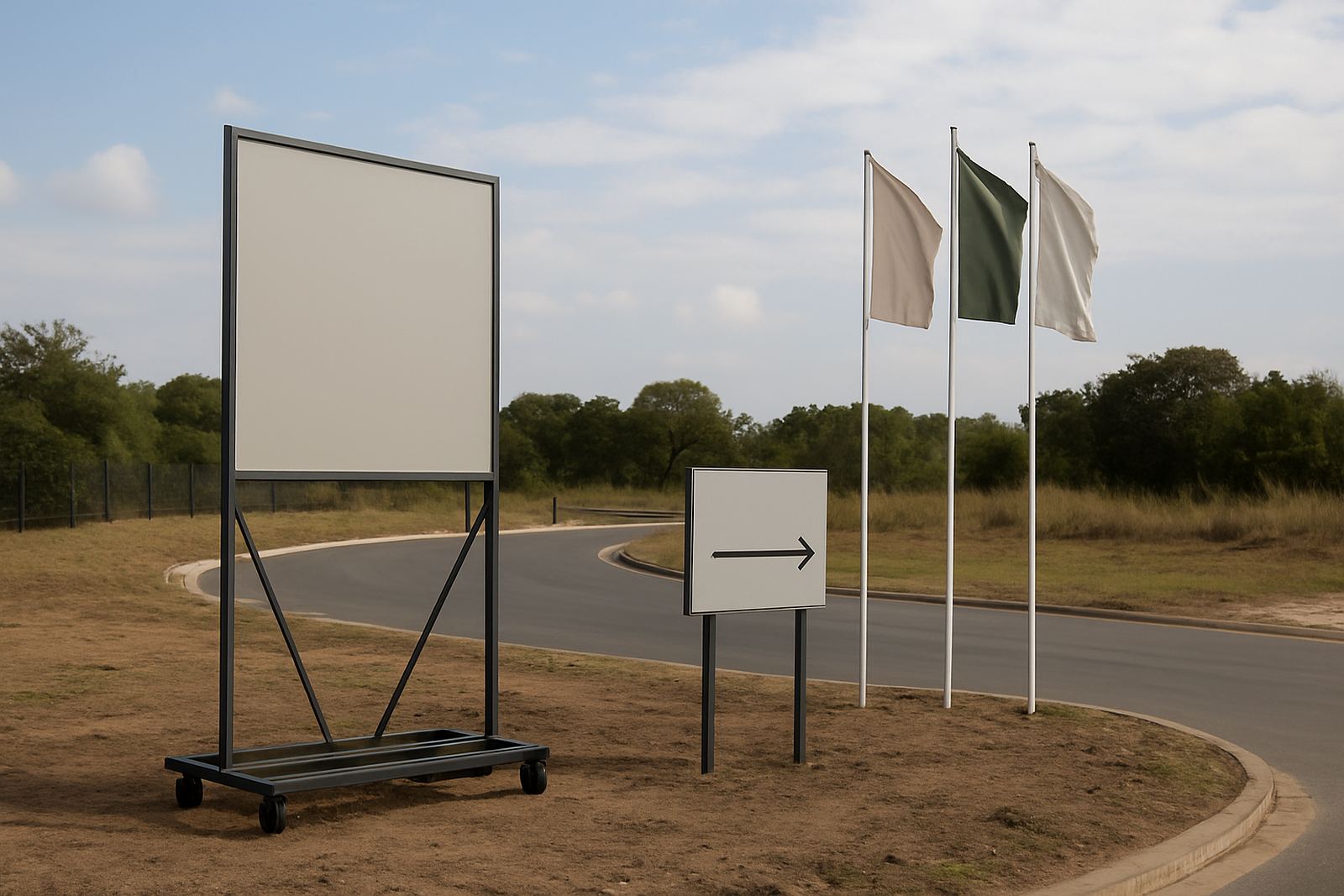
- Directional signs for visitors, parking and access
- Site rules and contractor notice boards
Typical Materials For Durban Property Sites
The right material depends on how long the sign must stay up and where it will stand. For short term listings, digitally printed corflute or rigid board is often enough. For longer projects, Chromadek is a practical choice because it handles weather well and keeps its shape. Perspex and ABS panels are used where a neater finish is needed for an office front, reception entry or marketing suite.
Window graphics are useful for sales offices and show units, especially when privacy is needed without making the space feel closed in. Contra-vision lets people see out while showing branding from the outside. Frosting works well for glass partitions, meeting rooms and entrance doors where you want a cleaner look with some privacy. In coastal areas, we usually recommend a printed finish with lamination where the sun is strong and cleaning is frequent.
- Chromadek boards for long lasting exterior use
- Perspex and ABS for a cleaner presentation
- Vinyl cut lettering for unit numbers and notices
- Large format prints for site boards and hoardings
- Lamination for added protection against UV and weather
Layout Planning For Better Visibility And Faster Decisions
A good property sign starts with the right layout, not the printer. The site name should be clear from the road, while smaller information should be set out in a way that people can scan quickly when they slow down or pull in. If there are multiple units or stands, use a simple numbering system and keep the contact details in one place. Too much copy makes the board look cluttered and the message gets lost.
We normally advise clients to think about sight lines, mounting height and vehicle movement before fabrication starts. If a sign faces a fast road in Pinetown or a corner site in Westville, the text needs to be bold and short. For gated estates and new developments, it also helps to plan for more than one sign type, because one board at the entrance is rarely enough on its own.
- Keep the main message visible from the road
- Use one font family and strong contrast
- Place prices and unit details where they can be read quickly
- Allow space for logos, approvals and compulsory notices
- Check the mounting surface before final sizing
Common Mistakes On Property Sites
The biggest mistakes are usually practical ones. Signs are often made too small, placed too low, or packed with too much information. Another issue is ignoring the site conditions. A board that looks good in a showroom may fail outside if it is not fixed properly, especially where wind gets up in open areas or where morning moisture sits on the surface. We also see signs damaged by poor installation, loose brackets or repeated removal and refitting.
Property clients sometimes forget the approval side too. Depending on the area and the type of site, local rules, estate controls or municipal requirements may affect size, position and wording. It is better to check these before printing than to redo the whole board later. A simple mistake can delay a launch by days and add extra cost that could have been avoided.
- Choosing the wrong size for road speed and viewing distance
- Using materials not suited to sun, rain or coastal humidity
- Overcrowding the board with too much text
- Skipping site checks before installation
- Not planning for permit or estate approval time
Site Surveys, Fabrication And Installation Across Durban
For property work, a site survey is worth doing properly. It helps with measurements, fixing points, access, wall condition and visibility from the street. In Briardene, Durban North and around Umhlanga Ridge, many sites need a combination of fabricated boards, printed panels and on-site installation. For bigger developments, we often handle both the signage itself and the fitting, which keeps the work aligned from start to finish.
Our team covers site surveys, artwork setup, large format printing, vinyl cutting, print lamination, sign fabrication, window installation and property sign removals when an old board needs to come down. We also do maintenance visits for signs that need replacing after weather damage, a change in tenant, or new phases coming online. During load-shedding, production timing matters, so planning ahead helps avoid delays in print and fitting schedules.
- New development branding
- Show unit and show house graphics
- Sale, let and occupancy notices
- Directional and compliance boards
- Refurbishment of older property signage
Budget Ranges For Property Signage In Rand
Property signage budgets vary depending on size, finish and how many boards are needed. A basic corflute or simple printed board for a listing can start from around R450 to R950, depending on size and mounting. Mid-range Chromadek boards or laminated prints for longer use often fall between R1 200 and R3 500. Larger development boards, multi-panel site signage and fitted entrance branding can run from about R4 500 to R15 000 or more, especially if there is fabrication, framing and installation included.
For larger estates or phased developments, it usually pays to price the whole site rather than one board at a time. That gives a better result on colour matching, sizing and consistency, and it is often easier to manage when the site changes over time. We can also stage the work so the first sign goes up quickly, then the rest follow as the development progresses.
- Entry level listing boards: R450 to R950
- Durable exterior boards: R1 200 to R3 500
- Large development signage: R4 500 to R15 000+
- Refurbishment and replacement costs depend on condition and removal
- Installation charges vary by access, height and fixing method