What Event Signage Needs to Do on the Day
Event signage has a simple job: guide people, carry the message, and keep looking right from first set-up through to pack-down. At launches, races, conferences and public activations, the signage has to work in daylight, under temporary lighting, and sometimes in wind or coastal humidity. In Durban, that usually means using materials and fixing methods that can handle quick changes and a fast-moving site.
For most event teams, the pressure is not just on print quality but on timing. Registration tables may change, sponsor logos may be updated late, and entrances can shift after a final site walk. We plan for that by keeping artwork practical, using legible type sizes, and choosing formats that are easy to install and remove without leaving damage behind.
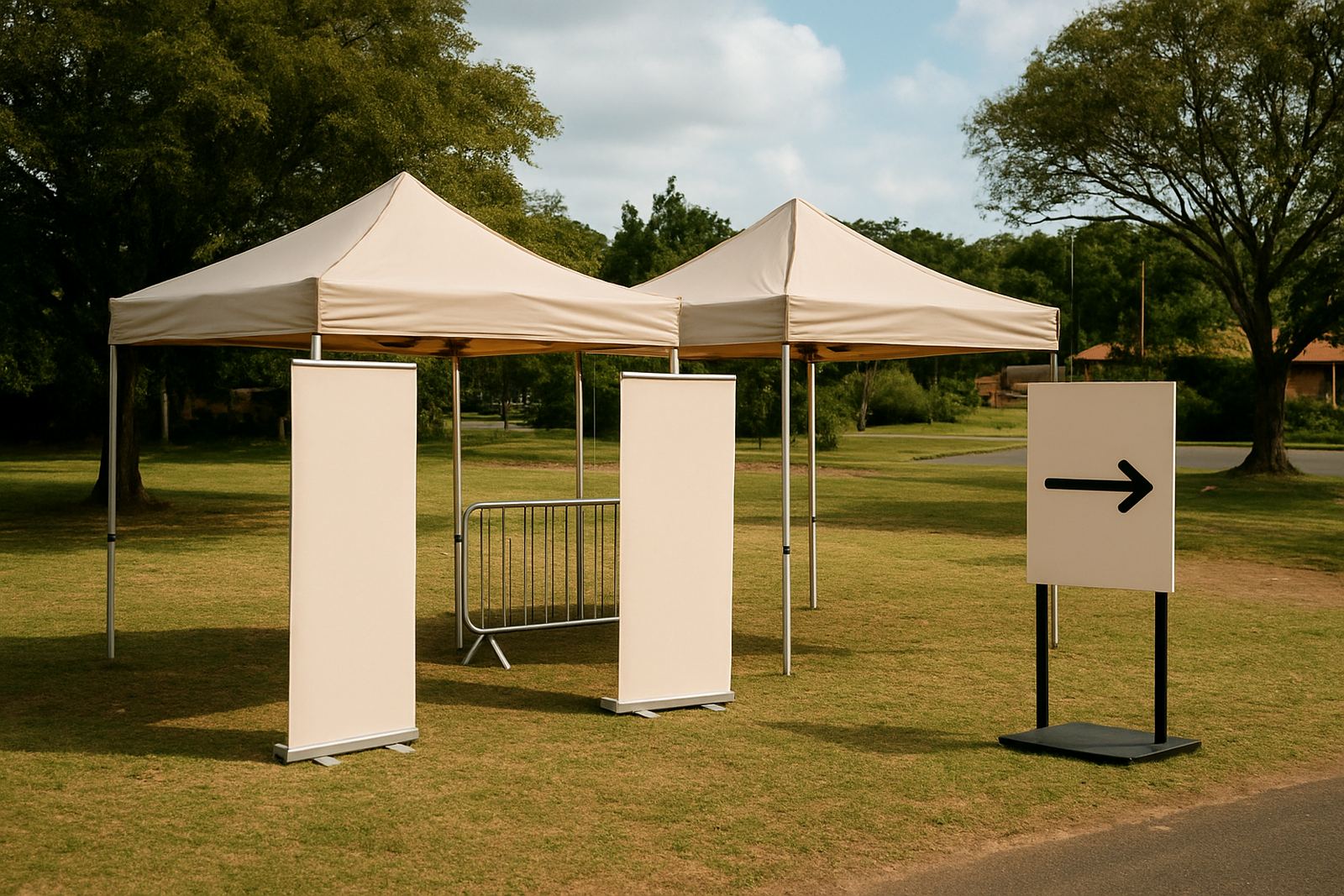
Common event signage includes directional boards, stage branding, sponsor panels, entry signs, pull-up or roll-up banners, directional floor graphics, light boxes for indoor areas, and window frosting for private meeting spaces. For outdoor events in eThekwini and along the North Coast, we also look at footing, ballast and safe placement so signage does not become a hazard if the wind picks up.
- Short viewing distance calls for larger text and stronger contrast.
- Coastal venues need materials that cope better with moisture and salt in the air.
- Last-minute changes should be planned into the artwork timeline from the start.
Typical Signage Set for Launches, Races and Conferences
The right mix depends on the venue and the crowd flow. A product launch in Umhlanga is usually more brand-led, while a race in Durban North or a public event in Pinetown may need more wayfinding and safety messaging. Conference signage usually leans on registration, room direction, sponsor recognition and branded backdrops for photos and media.
Our typical event set can include digital prints mounted to board, vinyl cut lettering, contra-vision for glass, Perspex or ABS directional signs, Chromadek boards for stronger outdoor use, and light boxes for areas that need visibility after load-shedding or in shaded venues. Roll-up banners suit entrances and smaller indoor spaces because they are quick to pack up and can be reused for repeated events.
For larger sites, we often split the signage into three groups: arrival signage, in-venue navigation, and sponsor or stage branding. That makes installation simpler and helps organisers see where the budget is going. It also makes re-use easier if the same event returns next year or moves between venues in Durban North, Westville, Verulam or Ballito.
- Arrival signs: entrance boards, parking arrows, drop-off points.
- Internal signs: registration, toilets, breakout rooms, stage direction.
- Branding items: sponsor walls, podium panels, media backdrops, light boxes.
Planning the Layout Before Printing Starts
Good event signage starts with the floor plan, not the printer. We usually ask for the venue layout, access times, mounting points and a clear run sheet for install and collection. If the site is outdoors, we also need to know whether the ground is grass, paving, tar or sand, because that affects the support system and fixing method.
For legibility, keep the wording short and use one message per panel where possible. Too much text becomes hard to read from across a forecourt or through a queue. At conferences, a clear room naming system helps a lot. If you use names like Hall A or Hall B, make sure they are consistent on the registration board, directional arrows and printed delegate packs. If the event is bilingual, plan the hierarchy so the main message still reads fast.
Artwork setup also matters. Files should be checked for correct bleed, safe margins and image quality before print. If you are using sponsor logos, collect them early and in the right format so the layout does not get squeezed at the last minute. A small change in logo spacing can affect a whole wall graphic, especially on larger branded boards or stage facias.
- Measure the actual installation space, not only the plan on paper.
- Allow for people, barriers, tables and camera lines.
- Check whether the venue allows adhesives, drilling or free-standing units only.
Materials That Work Best for Temporary and Reusable Events
The material choice depends on how long the signage must last and where it will be used. For one-day activations, printed boards and roll-up banners often give the best value. For repeated exhibitions or a launch that moves between branches, stronger options can pay off because they can be stored and used again. In coastal towns, moisture and heat can affect cheaper prints quickly, so we look at the environment before recommending a finish.
Vinyl cutting is useful for names, arrows and clean lettering on windows, vehicles or panels. Digital printing suits full-colour artwork, sponsor boards and photo backdrops. Lamination can help protect print surfaces from handling and light surface marks, especially where staff members are moving items on and off site throughout the day. For glass fronts, window frosting gives privacy without making the area feel closed in, and contra-vision is useful when you still want some outward visibility.
For events that run into the evening or happen under shade, light boxes improve visibility and keep the brand present after the sun goes down. If load-shedding is possible, we plan around battery backups, venue power and the fact that some spaces go dark with little warning. That is where simple readable signage matters most.
We also consider pack-down. Lightweight, portable items are easier for teams to move between hotels, conference centres and outdoor activation sites. If the same event repeats at different venues in eThekwini, having a reusable sign kit can save time and transport costs.
Common Mistakes That Cause Delays or Extra Cost
Most event signage problems happen before installation, not on site. The first is leaving artwork too late. If the message is still changing the day before the event, the print run can be rushed and errors creep in. The second is choosing the wrong format for the venue. A banner that works indoors may not hold up outside if the wind is strong or the fixing points are poor.
Another common issue is not matching the sign size to the viewing distance. A sign that looks fine at close range can disappear when people are arriving from a parking area or crossing a busy foyer. We also see organisers underestimate how many signs are needed for wayfinding. If people have to ask staff where to go, the layout probably needs another directional point.
Budget mistakes are often caused by changing the scope after production has started. If the event grows, it is better to add a second batch of signs than to keep redesigning the first set. That can be more cost effective and avoids inconsistent branding across the site.
- Do not approve artwork without checking the venue names and arrows.
- Do not assume indoor materials will survive outdoor exposure.
- Do not forget pack-down time, storage and re-use after the event.
Budget Ranges for Event Signage in Rand
Event signage budgets vary widely because size, quantity, material and installation all affect the final figure. As a practical guide, small indoor events with a few roll-up banners and printed direction signs may start from around R2,500 to R8,000. A mid-sized conference or launch with branded panels, window graphics and multiple wayfinding signs often sits between R8,000 and R25,000.
Larger public activations, races or multi-zone events can move into the R25,000 to R75,000 range, especially if there are stage backdrops, multiple sponsor boards, Perspex items, light boxes or several install and removal visits. If you need special mounting, after-hours work or fast turnaround across Durban North, Umhlanga or Pinetown, that can add to the total as well.
We usually recommend budgeting for three things: the printed items, the installation labour, and any extras such as lamination, site surveys or maintenance visits. That makes the quote easier to compare and helps avoid surprises when the event schedule tightens up. If the signage will be reused, it is worth spending a little more on materials that store well and keep their finish after several uses.
For organisers planning within a fixed budget, the best approach is to start with the essential signs first, then add sponsor pieces and decorative items once the route and core branding are covered.
How BP Signs Handles Event Work Across Durban and KZN
BP Signs works from Briardene in Durban North and supports event teams across eThekwini, Umhlanga, Pinetown and the KZN North Coast. We handle site surveys, artwork setup, large format printing, vinyl cutting, print lamination, sign fabrication, window installation, vehicle installation, shopfront installation, sign refurbishment, sign removals and maintenance visits. That means one supplier can manage the event from first measure-up to final pack-down.
Our team includes Bongani Patrick Zulu, Nokuthula Mkhize, Sashen Naidoo, Anele Dlamini, Priya Govender and Lindokuhle Khumalo, so the work is handled by people who know the pace of local events and the practical limits of venue access, loading bays and weather. If your activation is in a hotel, exhibition hall, retail centre or outdoor public space, we can advise on what will install cleanly and what will hold up best through the day.
If you need event signage that is clear, portable and ready for a Durban site, send your details through the enquiry form on our contact page. The sooner we see the venue plan and artwork, the easier it is to keep the schedule on track.