What directional signs do on a busy site
Directional signs give visitors, staff and delivery drivers clear instructions at the right point in the journey. On a site with more than one entrance, shared parking, service yards or separate buildings, proper wayfinding saves time and reduces confusion. It also helps with security control because people know where to go before they reach the wrong gate or reception.
We supply directional signs for indoor and outdoor use, from simple arrow plates to larger post-mounted panels and multi-tenant directories. Depending on the location, the sign can carry arrows, unit numbers, building names, parking instructions, pedestrian routes or restricted access notes. For estates and office parks in Durban North, Umhlanga and Pinetown, we often plan the sign sequence from the entrance right through to the final destination.
Common applications include office parks, industrial depots, schools, churches, retail centres, estates, hospitals, warehouses and event venues. In coastal areas like Ballito and Tongaat we also factor in salt air, sun exposure and heavy rain, so the materials and fixings are chosen for outdoor service not just a neat first day finish.
Sizes, layouts and material options
There is no single standard size because every site has different viewing distances and traffic speeds. A pedestrian sign near a foyer can be small and neat, while a driveway sign at a depot needs bolder lettering and better reflectivity if it will be read at dusk or after load-shedding. We make signs to suit the wall space, pole positions and the amount of wording required.
Directional signs can be made in a range of practical formats:
- Flat wall signs for entrances, corridors and reception areas
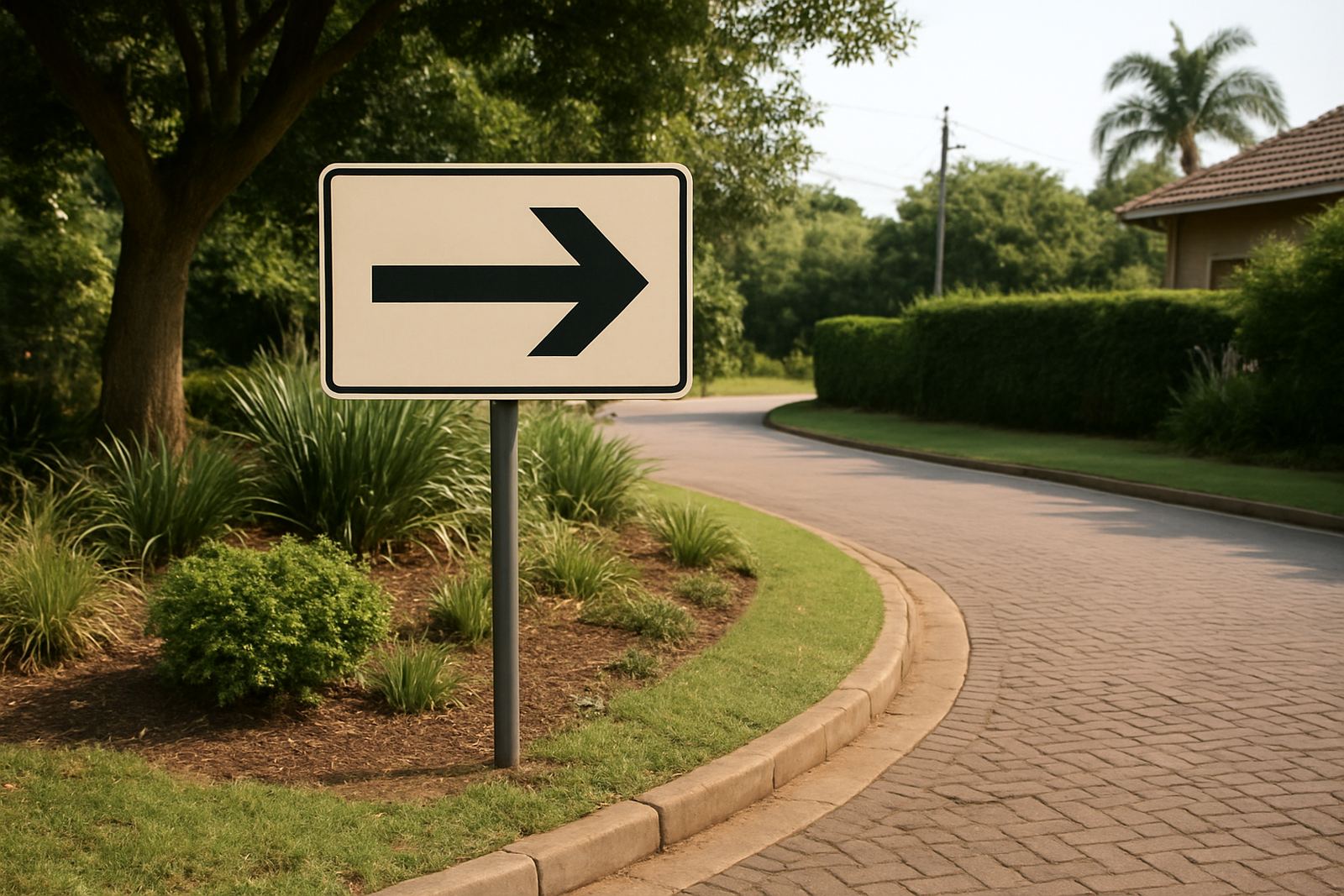
- Post-mounted signs for driveways, parking areas and estates
- Double-sided signs for routes that are approached from both directions
- Stacked panels for multiple tenants, departments or buildings
- Illuminated light box versions for low-light areas or long operating hours
Material choices usually include vinyl on rigid board, printed and laminated panels, Chromadek for outdoor durability, Perspex for a cleaner architectural look, and ABS for lighter indoor or semi-outdoor use. Lettering can be cut vinyl, printed graphics or a mix of both. If a site needs a premium finish, we can add frosted elements, contrasting colours and number panels so the route remains easy to read.
Where directional signs work best
Good wayfinding is most valuable where people have to make a decision quickly. That includes estates with security gates, office parks with multiple blocks, school campuses with separate grades, and industrial sites where visitors must check in before entering the yard. It also helps at churches, sports venues, conference areas and temporary event setups where parking and access change from one function to the next.
In eThekwini and surrounding areas, municipal access points, parking rules and pedestrian routes can vary from site to site. Directional signs help direct vehicles away from restricted areas and guide people to the correct entrance without confusion. For larger sites we often recommend a sign schedule that starts at the road edge, then continues through the gate, parking area and final building entry.
- Estates and gated developments
- Offices and business parks
- Schools, colleges and training centres
- Factories, depots and logistics yards
- Medical rooms, clinics and consulting spaces
- Event venues and temporary event access points
For sites with mixed traffic, such as staff cars, delivery trucks and pedestrians, we can separate the routes with colour coding or clear wording like staff parking, visitor entry and deliveries only.
Installation, fixing methods and power needs
Installation depends on the substrate and the location. Wall-mounted signs may be fixed with screws, stand-off fittings or adhesive systems where suitable. Free-standing directional signs are often mounted on galvanised posts set in concrete footings. For larger sites, we can install multiple signs in sequence so the first decision point leads naturally to the next one.
Illuminated directional signs require a power connection and should be planned with the electrical route in mind. We check whether the site has a nearby supply point, whether conduit is needed and whether the sign must be switched on a timer or photocell. In areas affected by load-shedding, an illuminated sign can still be useful if it is connected to backup power, but the layout must allow for safe maintenance and cable access.
Gas is not normally required for directional signs. If a site has special access needs, such as a low-voltage setup or battery-backed lighting, we will confirm those requirements during the site survey before fabrication starts. On outdoor signs, we also check wind exposure, wall condition and the fixing surface so the installation lasts through summer storms and strong coastal air.
Care, cleaning and ongoing servicing
Directional signs should stay readable all year, especially where visitors rely on them after hours. Basic care is simple: wash the surface with clean water and a mild soap, then wipe with a soft cloth. Avoid harsh abrasives, strong solvents and pressure washing at close range because that can lift graphics or damage the finish.
If a sign is exposed to direct sun, heavy traffic or sea air, we recommend periodic checks for fading, loose fixings and cracked panels. This is especially important for post-mounted signs and anything near the coast. Where a site changes its layout, we can update the wording, replace panels or refurbish the whole sign system so the route stays accurate.
- Check visibility at day and night
- Inspect fixings after heavy wind or rain
- Remove dirt, dust and insect build-up regularly
- Replace damaged panels before they become unreadable
- Review wording when buildings, tenants or parking routes change
We also handle sign removals and maintenance visits where a route has changed or a panel needs reworking.
What to confirm before you order
The best directional signage starts with accurate information. Before ordering, check the final spelling of all names, unit numbers, arrows and floor references. If your site has multiple access points, make sure the sign sequence is planned from the road through to the final destination. It is also worth confirming whether any wording must meet estate rules, school policies or site security requirements.
These are the main details to have ready:
- Site address and exact installation points
- Size of each sign and preferred viewing distance
- Indoor, outdoor or mixed-use location
- Material preference and finish
- Whether the sign is illuminated or non-illuminated
- Any loading bay, visitor or restricted access wording
BP Signs is based in Briardene, Durban North and works across Durban North, Umhlanga, Pinetown, Westville, Phoenix, Verulam, Tongaat and Ballito. Our team handles site surveys, artwork setup, fabrication and installation, so the finished directional system matches the site conditions and the way people actually move through it. Bongani Patrick Zulu leads the company with the production, sales and installation teams working closely on each job, from a small office directory to a full estate wayfinding system.
Key facts
| Typical sizes | 300 x 100 mm up to custom large format panels |
|---|---|
| Materials | Vinyl on rigid board, Chromadek, Perspex, ABS |
| Finish options | Matt, gloss, laminated, frosted, printed or cut vinyl |
| Mounting methods | Wall fix, stand-off fixings, post and concrete footing |
| Power needs | None for non-illuminated signs, mains power for light box units |
| Lead use | Estates, offices, depots, schools, venues and parking areas |