Safety marking for a busy production floor
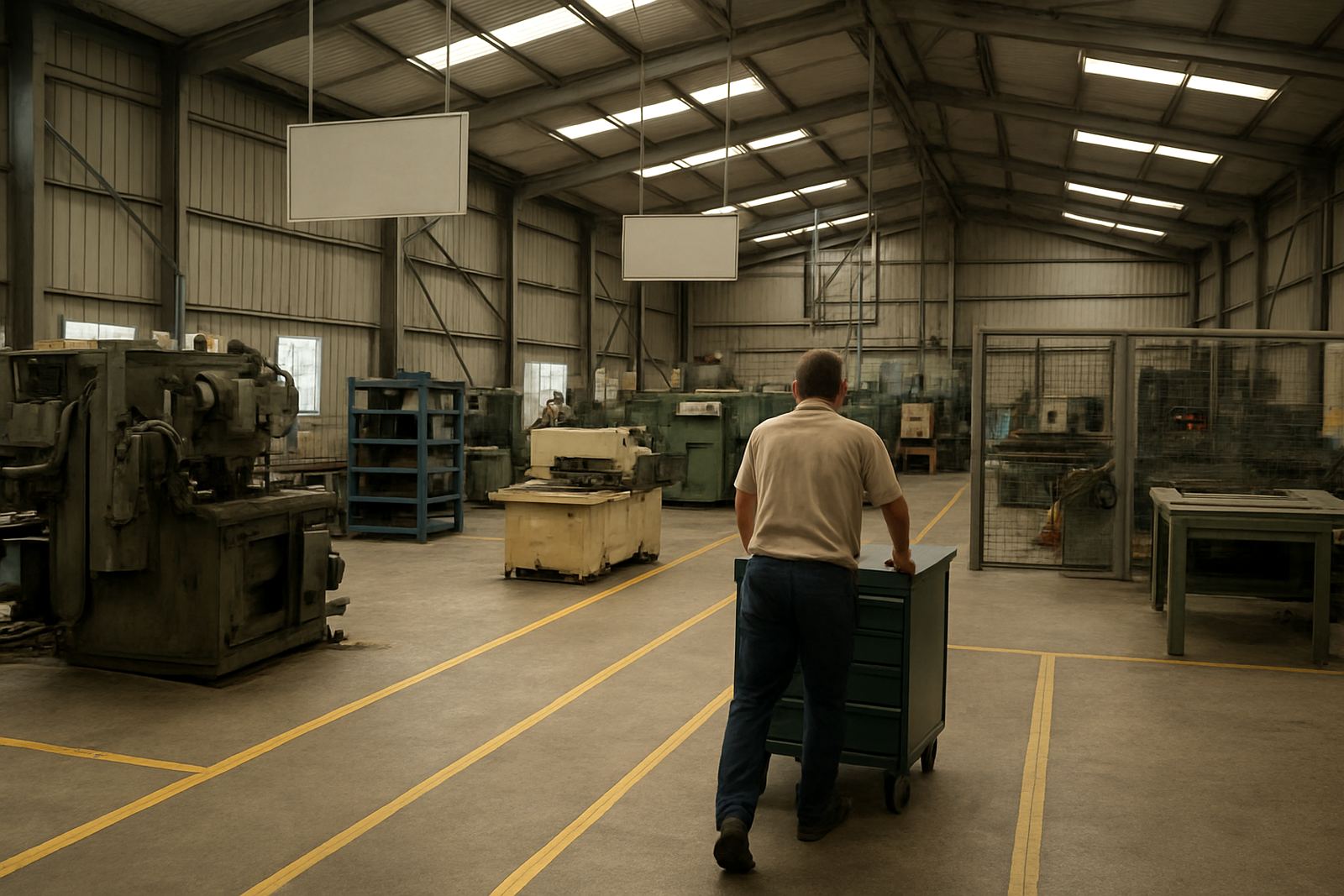
The client was a light industrial factory in Springfield, Durban, operating with forklifts, staff walkways, loading activity and daily deliveries. Their main concern was simple: people needed to move through the site without confusion, especially during shift changes and peak dispatch periods. They asked for a practical safety signage package that would hold up in a working factory and remain easy to read under fluorescent lighting and low-light load-shedding conditions.
Our brief was to update the production areas with mandatory signs, floor graphics and traffic markers that would support safer movement from the entrance through to the packing and loading zones. The site had a mix of concrete floors, painted surfaces and wall spaces with limited fixing points, so the materials and fixing method needed to suit each location. We also had to work around live operations, with no major shutdown and only short access windows for install work.
- Project type: factory safety signage
- Town: Springfield, Durban
- Site use: production, dispatch and internal traffic movement
- Key issue: clearer direction for workers, visitors and drivers
Survey, layout checks and compliance minded planning
We started with a site survey from our Briardene base in Durban North. The survey covered wall space, floor condition, walkways, truck routes, door swing areas and any points where signage could be damaged by trolleys or pallet movement. We measured the zones that needed marking and checked the viewing distance for each sign, since a notice that is too small or placed too low gets ignored fast.
The client also needed the layout to support basic workplace safety expectations, including clear pedestrian routes, hazard warnings, mandatory PPE notices and directional markers for vehicle movement. In a factory like this, signs cannot just look tidy. They must be fixed where people naturally look, and they must stay legible after cleaning, dust and regular foot traffic. We adjusted the artwork sizes to suit each surface and kept the message set direct and easy to understand.
- Site survey and measuring completed before production
- Artwork setup prepared for wall, floor and directional use
- Sign positions planned to avoid door arcs and traffic pinch points
What we supplied and installed
We supplied a mixed signage package made up of rigid signs, adhesive graphics and marked safety zones. Mandatory notices were produced on durable board for entrances and work areas, while the floor items were printed for high visibility and then laminated for added wear resistance. Traffic markers were used to define walking paths, loading edges and turning points where forklifts and pedestrians cross. The result was a site that reads more clearly from the first step inside the factory.
For the wall signs we used rigid panels with clean edges and drilled fixing points where required. For floor graphics, we prepared the surface properly so the adhesive would bond to the concrete and painted floors. The client wanted a neat finish that would not lift at the corners, so we kept to a practical install method and checked each piece after fitting. Small details mattered here, because a sign that peels or shifts becomes a trip risk pretty quickly.
- Mandatory safety signs for production and access points
- Floor graphics for pedestrian routes and hazard zones
- Traffic markers for vehicle movement and turning areas
- Surface prep, placement, fixing and final checks completed on site
Working around live operations and load-shedding
The biggest constraint was that the factory could not stop production for the full day. We scheduled the work in stages, first handling the areas with the highest risk and then moving into secondary zones once the floor was clear. Our installations lead coordinated with the client’s operations team so we could work between movement peaks and avoid blocking access to loading bays. That kept the site functioning while the new signage went in.
Load-shedding was another practical factor. Some install periods fell during reduced lighting, so we planned the sequence to use daylight where possible and carried the right tools for low-light finishing. We also worked around dust and cleaning cycles, since fresh floor graphics need a clean, dry surface. It was a straightforward job, but it needed discipline. One missed step in a factory can lead to rework or a sign that does not hold.
- Install completed in phases to avoid production stoppages
- Lighting and access planned around load-shedding periods
- Surface cleaning and drying checked before floor application
Timeline from survey to final handover
The project ran over two weeks from initial survey to final handover. Week one covered the site visit, measurements, artwork setup and sign approval. Week two covered manufacture, print preparation, lamination and installation on site in Springfield. Because the layout had multiple zones, we split the work into sensible sections rather than forcing the whole site into one rushed visit.
At handover, the client had a clearer factory flow and stronger visibility at the key control points. The signs gave staff a better sense of where to walk, where to stop and where vehicles had priority. The customer also appreciated that the graphics matched the factory layout instead of being generic. That matters in a working plant because people respond better to signs that reflect the space they use every day.
- Week 1: survey, measuring, artwork and approval
- Week 2: production, print, lamination and installation
- Final handover: site check and placement verification
Results on site and what we would repeat
The updated safety signage made the factory easier to move through and reduced uncertainty around pedestrian and vehicle movement. Mandatory notices were visible at the right points, the floor graphics helped guide staff through the production area and the traffic markers gave loading and turning spaces better definition. For a site like this, those small changes make daily operations calmer and more controlled.
If we were doing the same project again, we would follow the same process: survey first, confirm the traffic paths, then build the package around the real movement patterns on site. That is the most useful part of a factory safety job. It is not about filling walls with signs, it is about placing the right message in the right spot so people can act on it without second-guessing. We would also recommend a planned maintenance visit after a few months to check wear in the busiest zones and replace any items that have taken a knock.
- Clearer pedestrian and vehicle direction
- Better visibility at mandatory control points
- Recommended follow-up checks for high-wear floor areas
Key facts
| Client type | Industrial factory in Springfield, Durban |
|---|---|
| Scope | Mandatory signs, floor graphics and traffic markers |
| Materials | Rigid safety signs, printed floor graphics and adhesive markers |
| Process | Site survey, artwork setup, manufacture and installation |
| Timeline | 2 weeks from survey to handover |
| Service areas | eThekwini, Umhlanga, Pinetown and the KZN North Coast |